
Movolt: How Grid-Independent E-Truck Charging Works in Germany
A closer look at the Frankfurt clean-energy company using battery storage, renewable-energy logistics and managed charging infrastructure to address weak-grid locations.

Introduction
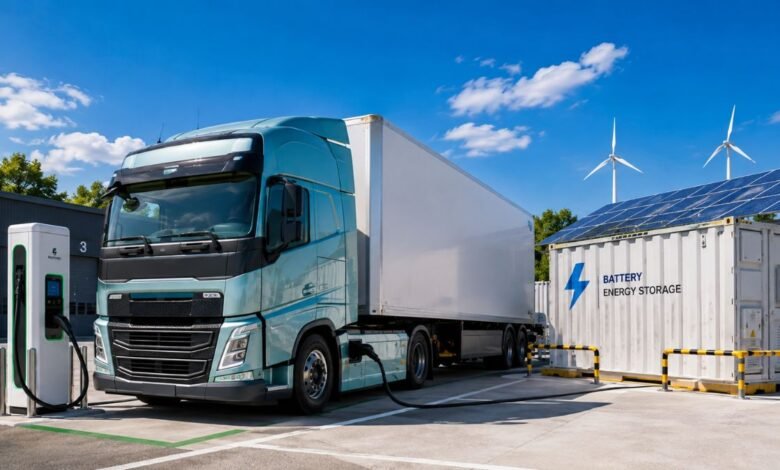
In the context of European transport electrification, Movolt most clearly refers to MOVOLT Truck GmbH. This Frankfurt-based energy-technology business develops and operates charging solutions for electric trucks at logistics sites where the available electricity-grid connection is insufficient. The company describes an integrated model that combines charging infrastructure, battery storage, renewable-energy logistics, operations, and a digital platform, rather than simply selling a standalone charger.
That distinction matters because electrifying a heavy commercial fleet involves more than purchasing electric trucks. Depot power capacity, charging schedules, grid connections, battery storage, load management, and day-to-day operations can all affect whether vehicles are ready when needed. Germany is consequently investing heavily in heavy-duty charging infrastructure, making companies focused on solving infrastructure bottlenecks increasingly relevant to the logistics sector.
Quick Answer
Movolt is a German e-truck charging infrastructure company focused on locations with weak or insufficient grid connections. Its stated approach combines battery storage, renewable energy, charging equipment, operational services, and software into a managed charging service for logistics businesses.
What Is Movolt?
MOVOLT Truck GmbH identifies itself as an energy-technology company based in Frankfurt am Main, Germany. Its LinkedIn company information lists 2025 as its founding year, while its official website gives its business address as Falkensteiner Str. 77, 60322 Frankfurt am Main.
Its core proposition is relatively specific: helping logistics businesses charge battery-electric trucks at sites where a conventional grid connection is unavailable, too weak, or too slow to expand. Instead of treating the grid connection as the starting point, MOVOLT says it designs the energy and charging system around the logistics location’s requirements.
The company therefore appears better understood as an energy and charging-service operator than simply as a manufacturer of EV charging hardware. Its published material discusses charging infrastructure, BESS, renewable-energy supply, operations, maintenance, software and integration. Publicly available information does not establish that MOVOLT manufactures every hardware component used in its installations itself, so describing it simply as a “charger manufacturer” would be unnecessarily specific.
How Does the Movolt Charging Model Work?
MOVOLT presents its system as an integrated service with several connected elements.
Charging Infrastructure
The first component is physical charging capability at the logistics location. MOVOLT says it provides the infrastructure required for e-truck charging rather than requiring the fleet operator to organise every part of the installation independently.
Heavy-duty charging presents a different infrastructure challenge from ordinary passenger-car charging. The European Commission specifically recognises that heavy-duty electric vehicles have different charging requirements and has established dedicated infrastructure objectives for them through the Alternative Fuels Infrastructure Regulation.
Battery Energy Storage
Battery storage is central to MOVOLT’s published proposition. The company says it combines battery storage with smart energy logistics to provide charging capacity at locations where available grid power would otherwise be inadequate.
This broader use of battery storage within truck-charging projects is not unique to MOVOLT. Germany’s current federal funding framework for heavy-duty electric-vehicle infrastructure explicitly includes battery storage, grid connections, charging equipment, and charging and load-management systems among eligible infrastructure areas.
Battery storage can therefore be viewed as one tool for separating the timing of electricity availability from the timing of vehicle charging demand. The exact engineering solution, storage capacity and charging configuration still depend on an individual depot’s energy demand, truck schedules and site conditions.
Renewable-Energy Supply and Energy Logistics
MOVOLT says it supplies green energy and uses what it describes as smart energy logistics. Its public website does not disclose enough technical detail to describe every energy-procurement or delivery mechanism accurately, so avoid claims about a specific supply architecture unless the company provides project-level documentation.
The important point is that the business proposition extends beyond installing charging posts. MOVOLT presents itself as coordinating energy supply, storage, charging and operation as one service.
Operations and Digital Integration
MOVOLT also says it handles operation and maintenance and uses its own digital platform as part of the charging service. Its contact options specifically reference software, cloud and integration, indicating that digital coordination is part of the wider offering.
For a logistics operator, this matters because a charging system must ultimately fit vehicle schedules. Electricity availability alone does not guarantee that the correct truck will receive the required charge before departure.
What Does “Grid-Independent” Actually Mean?
The phrase grid-independent charging needs careful interpretation.
MOVOLT states that its service can enable charging without requiring grid expansion or a grid connection at the customer’s location and that battery storage and renewable-energy logistics form part of its approach.
That should not automatically be interpreted to mean that every MOVOLT installation is a permanently isolated, self-sufficient energy island. The company’s public website does not publish enough project-specific engineering information to justify such a broad technical conclusion.
A more accurate description is that MOVOLT aims to make e-truck charging possible without making a stronger local grid connection the immediate prerequisite.
That distinction matters for temporary logistics sites, rapidly expanding depots, or businesses facing lengthy grid-upgrade processes.
Movolt Versus Conventional Grid-Based Depot Charging
| Area | Conventional Depot Approach | MOVOLT’s Stated Approach |
|---|
| Starting point | Available or upgraded grid connection | Requirements of the logistics site |
| Energy storage | May be added where useful | Battery storage is part of the stated model |
| Infrastructure investment | Usually project-specific | MOVOLT markets a service model without customer infrastructure CapEx |
| Energy management | Can use load-management systems | Integrated with energy logistics and digital systems |
| Operations | Fleet owner or contracted provider | MOVOLT says it manages operations and maintenance |
| Main use case | Sites with sufficient power or feasible upgrades | Locations with weak, unavailable or delayed grid capacity |
MOVOLT describes its commercial offering as requiring no infrastructure CapEx from the customer, with customers paying for energy consumed. This is the company’s stated commercial model, not an independently audited cost comparison, and contractual conditions could vary by project.
Why This Approach Matters for Electric-Truck Fleets
Truck electrification creates unusually concentrated electricity demand. A fleet depot may need to recharge several high-capacity commercial vehicles during limited parking windows, making charging power and scheduling particularly important.
Germany’s National Centre for Charging Infrastructure identifies charging capacity, grid connections, construction planning and dependable operation as important considerations when developing depot infrastructure. It also highlights smart load management as a way to use existing grid capacity more effectively and reduce peak demand.
The issue is receiving substantial policy attention. In 2026, Germany’s Federal Ministry of Transport launched a programme making €1 billion available over four years to support charging infrastructure for battery-electric heavy-duty commercial vehicles. The framework covers both depot and publicly accessible charging projects and can support battery storage and load-management technology alongside chargers and grid connections.
At the European level, the Alternative Fuels Infrastructure Regulation has been in force since 13 April 2024. It sets targets for alternative-fuel infrastructure, including charging for heavy-duty vehicles along key TEN-T transport routes, urban nodes, and certain parking locations.
These developments do not guarantee the success of any individual charging company, but they demonstrate why heavy-duty charging infrastructure has become a serious transport and energy-market issue.
Who Could Movolt Be Relevant For?
Based on its published positioning, the service is most relevant to fleet operators, haulage companies, logistics businesses and parking-facility operators considering electric trucks but facing limitations at a specific site. MOVOLT’s own enquiry form identifies those groups among its intended customer categories.
Potentially relevant scenarios include a depot with insufficient grid power, a grid expansion that will not be completed before electric vehicles arrive, a temporary logistics facility, or a growing site where fleet electrification is outpacing electrical infrastructure.
The model is less obviously necessary where a company already has abundant grid capacity and can economically build and manage its preferred charging infrastructure. In those circumstances, fleet operators would need to compare the economics and flexibility of a managed service against owning the infrastructure directly.
What Businesses Should Check Before Choosing a Solution
A company evaluating MOVOLT or any comparable heavy-duty charging service should look beyond the headline promise of getting trucks charged.
Important questions include the guaranteed charging capacity, energy availability, service-level commitments, battery-storage design, charger compatibility, vehicle scheduling, contract duration, energy pricing formula, maintenance responsibilities, and the plan for future fleet growth.
Companies should also establish what happens if charging demand increases substantially, a permanent grid upgrade becomes available later, or the depot moves. These factors can determine whether a service-based approach remains economically attractive over the full operating period.
Because MOVOLT’s public website does not currently publish detailed standardised technical specifications, project economics or large-scale customer case studies, potential customers would need project-specific documentation before making an investment or contractual decision.
Is Every “Movolt” Search Result About the Same Company?
No. This is an important search ambiguity.
Online results also contain Movolt-branded solar panels offered by Wonvolt Holdings Limited and an Intelbras product called the “movolt tower” UPS. Those listings are different product contexts, and available evidence does not establish that they belong to MOVOLT Truck GmbH in Frankfurt.
Readers researching the German e-truck business should therefore look specifically for MOVOLT Truck GmbH rather than assuming every product carrying the word Movolt comes from the same organisation.
MOVOLT Solutions GmbH also appears separately on LinkedIn as a Frankfurt renewable-energy business specialising in areas including BESS, project development and photovoltaic systems. Public information reviewed for this article is not sufficient to define the precise legal or ownership relationship between MOVOLT Solutions and MOVOLT Truck, so the two should not be casually presented as one corporate entity without additional documentation.
FAQs
What is Movolt?
In this context, Movolt most relevantly refers to MOVOLT Truck GmbH. This Frankfurt-based company develops and operates charging infrastructure for electric trucks, particularly at logistics locations with inadequate grid capacity.
Where is Movolt based?
MOVOLT Truck GmbH lists its address in Frankfurt am Main, Hesse, Germany. Its LinkedIn profile also identifies Frankfurt as its headquarters.
When was MOVOLT Truck founded?
The company’s LinkedIn profile lists 2025 as its founding year.
Does Movolt require a grid connection?
MOVOLT states that its model is designed to provide e-truck charging capability at locations without an adequate grid connection and says grid expansion or a new grid connection is not required for its stated service model. Exact technical configurations can differ by project.
Is Movolt a battery manufacturer?
Public information describes MOVOLT as developing and operating charging infrastructure and combining battery storage with energy logistics. It does not clearly establish MOVOLT Truck as a manufacturer of the battery cells or all hardware used in its systems.
Are Movolt solar panels part of MOVOLT Truck?
That connection should not be assumed. Search results contain Movolt-branded solar products from other sellers and manufacturers, while MOVOLT Truck’s official material centres on heavy-duty charging infrastructure. Research found no verified corporate connection between those solar products and MOVOLT Truck.
Final Takeaway
MOVOLT occupies a specific part of the emerging electric-truck ecosystem: solving the energy-infrastructure problem when a logistics company’s local grid cannot immediately support its charging requirements.
Rather than presenting itself simply as a charger supplier, MOVOLT Truck combines charging infrastructure, battery storage, renewable-energy logistics, operations and digital integration into a managed service.
The concept is particularly timely as Germany and the wider EU expand infrastructure for battery-electric heavy transport. Its long-term commercial significance, however, will depend on factors that public information cannot yet fully answer, including project economics, deployment scale, contractual performance and documented operating results.
For readers searching for Movolt, the key is also to distinguish the Frankfurt e-truck company from unrelated solar, UPS and similarly named energy products.
