
Mediterranean Corsica: History, Culture and the Identity of France’s Island
From Genoese citadels and Pasquale Paoli to Corsican language, polyphonic song and Napoleon’s Ajaccio, the island carries a Mediterranean identity distinctly its own.

Introduction
Mediterranean Corsica is the French island of Corsica viewed through the lens of the geography, history, and culture that connect it to the wider Mediterranean world. Sitting west of Italy and immediately north of Sardinia, Corsica is politically part of France. However, it has developed a distinctive identity through centuries of Mediterranean migration, conquest, trade and cultural exchange.
It is the Mediterranean’s fourth-largest island by surface area and one of its most mountainous. Since 2018, Corsica has been governed as a French collectivité à statut particulier, or special-status territorial collectivity. France’s national statistics institute estimates its population at 365,636 in 2026, although that figure is provisional.
What makes Corsica particularly interesting is that its identity cannot be reduced to “French with Italian influence”. Its own language, political history, mountain communities, religious traditions, music and cuisine have developed from a much more complicated Mediterranean story.
Quick Answer: What Is Mediterranean Corsica?
Mediterranean Corsica refers to the mountainous French island of Corsica in the western Mediterranean Sea. It is known for a culture shaped by prehistoric settlement, Greek and Roman connections, centuries of Pisan and Genoese influence, an eighteenth-century independence movement and more than two centuries of political association with France.
Its Mediterranean identity remains visible in its architecture, Corsican language, food, religious customs, historic towns and traditional music.
Where Is Corsica in the Mediterranean?
Corsica occupies a strategically important position between southern France, the Italian peninsula and Sardinia. It covers roughly 8,700 square kilometres, and the French regional prefecture describes it as the most mountainous of the three large islands of the western Mediterranean. Ten mountain massifs have summits above 2,000 metres, with Monte Cinto reaching around 2,710 metres.
That mountainous interior matters culturally as much as geographically. For much of Corsican history, valleys, upland villages and difficult routes limited movement between communities. The result was a strong attachment to villages, local landscapes and regional customs even as successive outside powers controlled the coast.
| Place or feature | Why it matters culturally |
|---|
| Ajaccio | Administrative capital and birthplace of Napoleon Bonaparte |
| Corte | Centre of Pasquale Paoli’s eighteenth-century Corsican government |
| Bastia | Major surviving centre of Genoese architecture and urban history |
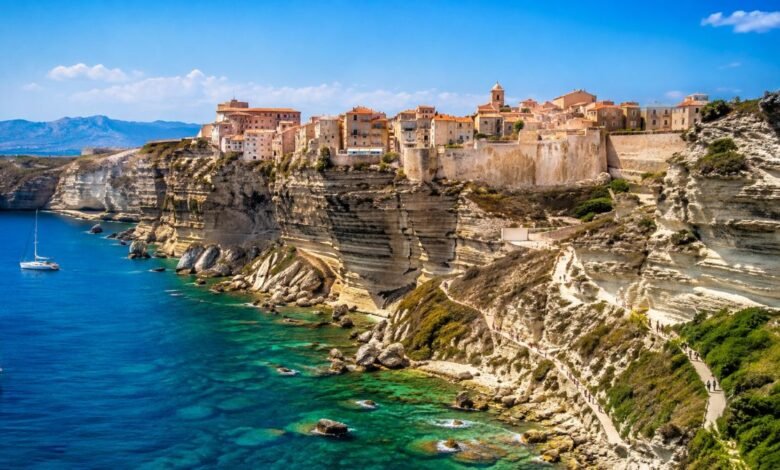
| Bonifacio | Historic fortified town above dramatic limestone cliffs |
| Filitosa and other prehistoric sites | Evidence of Corsica’s deep pre-Roman past |
| Corsican mountains | Landscape that helped shape village life, pastoral traditions and regional identity |
Corsica’s History Began Long Before France
Corsican history reaches back thousands of years.
Archaeological evidence shows human occupation dating back to deep prehistory, while megalithic sites and standing stones remain among the island’s most striking ancient monuments. The official Corsican tourism authority traces settlement to at least the eighth millennium BC and identifies later megalithic and Torrean cultures as major elements of the island’s prehistoric heritage.
Greek settlers established Alalia, the modern Aléria area, in the sixth century BC. Roman control followed later, tying Corsica more closely to the political and economic networks of the ancient Mediterranean.
This long history is important because Corsica was rarely isolated from surrounding civilizations. The sea could separate the island from continental powers, but it also connected Corsica to Italy, Sardinia, southern France and the wider Mediterranean.
How Genoa Left Its Mark on Mediterranean Corsica
Among the most visible historical influences is that of the Republic of Genoa.
Pisa exercised considerable influence during the medieval period before Genoa became the dominant maritime power. By the fourteenth century, Genoese authority had become established across much of Corsica and would shape the island for centuries.
Today, that era survives physically in citadels, coastal fortifications, churches, ports and town plans.
Bastia offers a particularly clear example. Its original fortress was founded by the Genoese governor Leonello Lomellini in 1380, while the later governor’s palace and defensive works became major symbols of Genoese rule.
Bonifacio, Calvi and Ajaccio also preserve strong architectural traces of the period.
The result is one reason visitors occasionally perceive an Italian quality in Corsican towns. That resemblance is not accidental, but Corsican culture should not simply be reduced to an extension of Italy. Centuries of local development produced something recognizably different.
Pasquale Paoli and the Corsican Independence Era
The eighteenth century transformed Corsica’s political identity.
After prolonged resistance to Genoese rule, Pasquale Paoli emerged as the central figure in a Corsican independence movement. In 1755 he became the island’s leader and established a government centred on Corte, with a constitution and new political institutions.
Corte therefore holds a place in Corsican history that goes well beyond its dramatic mountain setting. For visitors interested in understanding modern Corsican identity, it is arguably as important as coastal Ajaccio or Bonifacio.
Genoa eventually ceded its rights over Corsica to France in 1768. Corsican resistance continued until Paoli’s forces were defeated at Ponte Novu in 1769, after which organized resistance was broken and Paoli went into exile.
That sequence explains an important point: Corsica did not simply pass peacefully from “Italy” to France. Eighteenth-century Corsican independence and resistance remain important parts of the island’s historical memory.
Napoleon and Ajaccio
Only months after the decisive events of 1769, another figure central to European history was born on the island.
Napoleon Bonaparte was born in Ajaccio on 15 August 1769. His family home is now the Musée National de la Maison Bonaparte, and the city retains numerous sites associated with the Bonaparte family.
Napoleon’s fame has inevitably become one of Ajaccio’s major visitor attractions, but reducing the city to Napoleon alone would miss much of its character.
Ajaccio also contains its Genoese-founded citadel, Mediterranean waterfront, markets, religious architecture and old-town streets. The official Corsican tourism board describes it as the island’s administrative capital and highlights both its Napoleonic and wider architectural heritage.
Corsican Language and Cultural Identity
One of the clearest expressions of Corsican identity is Corsu, the Corsican language.
Corsican is a Romance language with particularly strong historical linguistic connections to varieties spoken in central Italy. French, however, is the language of the French Republic and dominates official administration.
Corsican has nevertheless retained an important cultural and educational role. France’s Ministry of Education continues to provide formal Corsican-language programmes in secondary education, including dedicated regional-language study programmes for the 2026–27 academic year.
Travel around the island also reveals Corsican forms of place names, including Aiacciu for Ajaccio and Corti for Corte.
Language here is more than a tourist curiosity. It connects contemporary Corsica with literature, music, oral traditions and ongoing debates about how island culture should be preserved.
The Music Tradition That UNESCO Says Needs Safeguarding
Corsican polyphonic singing is among the island’s most recognizable cultural traditions, but one form deserves particularly precise treatment.
Cantu in paghjella is a male vocal tradition using three interlocking registers. It can be performed in secular, social, and religious settings and has traditionally been transmitted orally.
UNESCO inscribed Cantu in paghjella in 2009 on its List of Intangible Cultural Heritage in Need of Urgent Safeguarding. The organization specifically identifies the decline in intergenerational transmission as a threat to the tradition.
That distinction matters. Paghjella should not be treated simply as entertainment staged for visitors. Its significance lies in the communities, religious practices, social gatherings and oral transmission that give the music its cultural meaning.
Religion, Festivals and Village Traditions
Catholic traditions remain highly visible in Corsican cultural heritage.
Churches range from Romanesque chapels to elaborate Baroque buildings, while religious festivals and processions continue in towns and villages. Bonifacio, for example, maintains notable Holy Week traditions involving historic religious brotherhoods.
Traditional culture also extends to craft.
Knife-making, pottery, jewellery, basketry and other forms of craftsmanship remain part of the island’s cultural economy. In areas such as Balagne, workshops and artisan routes give travellers opportunities to see how some of these traditions continue beyond museum displays.
Corsican Food Tells the Story of the Landscape
Corsican cuisine makes little sense if it is considered only as “French Mediterranean food”.
The island’s mountains, livestock traditions, chestnut groves and agricultural micro-regions have shaped a cuisine rooted as much in the interior as on the coast.
Brocciu is perhaps the most distinctive example. Produced using sheep’s or goat’s milk whey and additional milk, it appears in both savoury dishes and desserts such as fiadone. Corsican gastronomy also makes extensive use of charcuterie, chestnut flour, cheeses, olive oil and local wines.
This creates an interesting contrast with the stereotype of Mediterranean islands as primarily seafood destinations. Seafood certainly matters around Corsica’s long coastline, but pastoral and mountain foods are equally important to understanding traditional island cooking.
Four Places That Best Explain Corsican History
Corte: The Political Heart
For the independence era, Corte is indispensable. Paoli made it the centre of his government, and its inland citadel still rises dramatically above the town. The official tourism authority describes Corte as fundamental to Corsican history and notes its unusual position as the island’s only inland citadel.
Bastia: The Genoese City
Bastia gives visitors perhaps the clearest urban impression of Genoese Corsica. Its old port, citadel and Terra Nova district reveal the architecture of a period when Genoa controlled the island.
Ajaccio: Corsica and France Intersect
Ajaccio is where the island’s Genoese heritage, French political history and Napoleonic legacy overlap. For first-time visitors, it provides one of the easiest introductions to Corsica’s layered identity.
Bonifacio: History Above the Sea
At Corsica’s southern edge, Bonifacio rises above pale limestone cliffs overlooking the strait toward Sardinia. Some buildings stand more than 70 metres above the water, making the fortified upper town one of the island’s most dramatic combinations of landscape and history.
Why the Mountains Matter as Much as the Beaches
Search results for Corsica naturally emphasize turquoise water and beaches, but the island’s mountains are just as important to its identity.
The celebrated GR20 runs for roughly 180 kilometres through the high country and is described by Corsica’s official tourism organization as one of Europe’s most difficult high-altitude long-distance trails.
For a cultural traveller, however, the mountains matter for another reason: they lead into the villages and landscapes where pastoral farming, chestnut cultivation, traditional food and regional customs developed.
Someone who sees only the beaches therefore sees only part of Corsica in the Mediterranean.
What Is Corsica’s Political Status in 2026?
Corsica remains part of the French Republic and, under current law, continues to operate as a special-status territorial collectivity, a structure introduced on 1 January 2018.
There is, however, a significant constitutional debate underway.
On 23 June 2026, France’s National Assembly approved at first reading a constitutional bill proposing autonomous status for Corsica within the Republic. The bill was transmitted to the Senate on 24 June 2026, so the National Assembly vote alone did not make Corsica autonomous. As of August 2026, the existing legal status therefore remains the relevant one while the constitutional process continues.
This current debate also demonstrates why language, history and island identity are not merely historical topics in Corsica. They remain active questions in contemporary public life.
How to Experience Mediterranean Corsica Through Its Culture
A history-focused visit works best when coastal cities are combined with the interior.
Ajaccio introduces the story of the Bonapartes and Corsica’s relationship with France. Corte provides context for Paoli and the period of independence. Bastia exposes the Genoese urban legacy, while Bonifacio connects maritime geography with centuries of defensive architecture.
Archaeological sites add the much older Mediterranean story, while village churches, markets, traditional food and music reveal forms of heritage that remain alive rather than preserved only behind museum glass.
The most rewarding approach is therefore not to ask whether Corsica feels “more French or Italian”. Its history explains why it contains elements connected to both worlds while maintaining an identity that cannot comfortably be reduced to either.
FAQs
Is Corsica in France or Italy?
Corsica is part of France. Its location close to Italy and centuries of Pisan and Genoese influence help explain its strong historical connections with the Italian peninsula.
Is Corsica a Mediterranean island?
Yes. Corsica lies in the western Mediterranean Sea, north of Sardinia and west of mainland Italy.
What is Mediterranean Corsica famous for?
It is known for its mountainous scenery, historic Genoese towns, beaches, Napoleon’s birthplace in Ajaccio, Pasquale Paoli, the Corsican language and music, traditional food, and the GR20 hiking route.
Why does Corsica have Italian influences?
Corsica spent centuries within the political and cultural orbit of Italian maritime powers, particularly Pisa and Genoa. Its language and architecture preserve important evidence of those historical links.
Is Corsica autonomous in 2026?
Not yet under the proposed constitutional arrangement. Corsica currently remains a French special-status territorial collectivity. The National Assembly approved an autonomy proposal in June 2026, but the constitutional process had not been completed as of August 2026.
Final Takeaway
Mediterranean Corsica is far more than a French beach island. Its real character becomes clearer when geography and history are considered together.
Prehistoric monuments connect it with the earliest communities of the Mediterranean. Genoese citadels recall centuries of maritime rule. Corte tells the story of Pasquale Paoli and Corsican self-government. Ajaccio links the island to Napoleon and modern French history, while Corsican language, paghjella singing, religious festivals and traditional foods preserve cultural practices that remain meaningful today.
Corsica belongs politically to France, but its story was written across the Mediterranean. That layered identity is precisely what makes the island culturally distinctive.